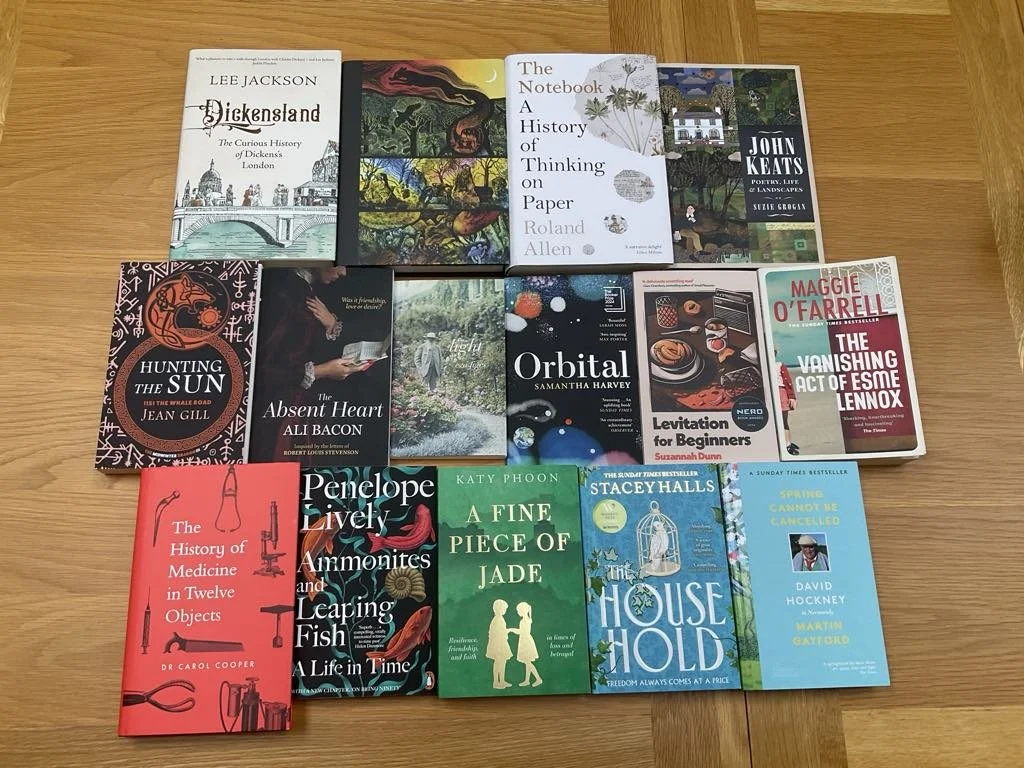
A selection of my favourite reads in 2025 - many others were on Kindle
It’s February, so this post is pretty late, I know, but as I started the year with my third encounter with Covid, I think you may forgive me. I’m back with my annual round-up of reading: over 60 books again and many of them non-fiction. Some were re-reads because I am so fond of them. Some were by friends or editorial clients (who often become friends too!)
Here are the highlights of my 2025 year of reading, in alphabetical order by surname.
Non-fiction:
Roland Allen: The Notebook: A History of Thinking on Paper. I loved, loved, loved this book and found every page fascinating. A gorgeous hardback made for a stationery addict like me!
Carol Cooper: The History of Medicine in Twelve Objects. Wittily told and full of fascinating – and often shocking details that make you glad not to have been an invalid in past centuries.
Ann Merle Feldman: Fierce over Fifty. An urgent, passionate exploration of how women can drive themselves to physical burnout and what to do about it.
Anna Funder: Wifedom: Mrs Orwell’s Invisible Life. Doesn’t make you feel keen on George Orwell …
Martin Gayford: Spring Cannot be Cancelled: David Hockney in Normandy. A joyous, inspirational celebration of art and of simply being alive.
Suzie Grogan: John Keats – Poetry, Life and Landscape. What sets this book on Keats apart is the author’s passion for the man himself and the places that inspired him. Follow in his footsteps via these compelling essays on locations Keats visited or stayed in. I’ve read this book more than once and enjoy it even more each time.
Lee Jackson: Dickensland. A sprightly survey of places that mattered to Charles Dickens, painting a portrait of an era we all think we know because we’ve watched Great Expectations and A Christmas Carol. Nuggets of information like sixpences stirred into a plum pudding.
Penelope Lively: Ammonites and Leaping Fish, a Life in Time. I think this is a wonderful book, wise, waspish, evocative. Like the David Hockney book mentioned above, it factors in ageing and how to cope with or rise above it and keep finding life full of meaning.
Sarah Ogilvie: The Dictionary People. Loads and loads of fascination here, if you are a bibliophile and a wordaholic, as I am.
Fiction
Ali Bacon: The Absent Heart. We’ve all heard of Robert Louis Stevenson and we may have heard of his American wife Fanny – but we may not have heard of a different relationship, one which unfurled over many years, based on longing and admiration, but ultimately much more complicated than that. I loved the delicacy of the writing here and the close psychological exploration of love in various forms and how a woman might make her mark in a male-dominated 19th century literary scene.
Sean Cunningham: Storm’s Edge. This marks the start of a new urban fantasy series from a writer who writes brilliant dialogue, high octane action scenes and has one of the most fertile imaginations I’ve come across.
Suzannah Dunn: Levitation for Beginners. A novel with a teenage narrator – one who lives in the early 1970s. It captures the era really well (speaking as one who lived in it …)
Eva Figes: Light. Set at Monet’s house in Giverny, this beautiful little book imagines the people in his orbit and the tyranny of art over the artist and all who deal with him. This was a real discovery, this book: it is gorgeously written and catches the subtleties of the changes of light in the course of a fleeting day just as Monet himself always sought to do.
Clare Flynn: The Star of Ceylon. Clare’s books are always a mix of romance, location and a passionate message. Here, it’s the question of women’s education in the early 20th century. Start rooting for yet another of her rebel heroines (and read her guest-blog for Fictionfire here [link])
Jean Gill: Hunting the Sun – third in her wonderful 12th century Viking series, where the action turns to Sicily. Gripping – and moving. The fourth in the series will be published this year!
Samantha Harvey: Orbital. Like the Eva Figes book mentioned above, this one is deceptively short, but don’t think for one moment that means short equates with insubstantial. This is full of poetic prose and philosophical thought and it’s the kind of book you know you will have to come back to and dwell in. This is not a read once and throw away kind of book.
Stacey Hall: The Household. A historical read based on Urania Cottage, the home set up for fallen women by Charles Dickens and Angela Burdett Coutts. I loved how she spun the social facts into such a compelling novel.
Anna Mazzola: The Book of Secrets. Another historical read based on real events, this one set in 17h century Rome. A mixture of crime and magic.
Alison Morton: Double Identity and Double Pursuit. Crime again, but this time in modern Europe. Fast, pacey, full of tech knowledge – Alison Morton’s new series is fun to read and I’m looking forward to the third one, which she published in 2025 but which I haven’t got to yet!
Maggie O’Farrell: The Vanishing Act of Esme Lennox. A complex, fairly slow start but oh my, utterly gripping by the end! It ranges through time, using different narrative voices. The delicacy of progressive revelation is expertly handled, as you would expect from so fine a writer.
Katy Phoon: A Fine Piece of Jade. The upheavals of 20th century life in China are beautifully – and often heartbreakingly – evoked in this novel, based on the life of the author’s mother. The Second World War and the Cultural Revolution form the backdrop to a tale of enduring friendship.
Colm Toibin: Brooklyn (reread). He is so good on the ambivalence felt by those who leave home. The excitement of new experience, the tug at the heartstrings when remembering the past …
Debbie Young: Death at the Village Chess Club. Cosy, playful, fun. I’ve said before how Debbie has such a great eye for village life , which provides endless inspiration for her various series.
Other:
Fate – Tales of History, Mystery and Magic. An impressive anthology of stories which showcases how well each contributor knows the era they are describing. Adventure, myth, battles, romance, power and delusion – they’re all there!
Richard Flanagan: Question 7. Is it a novel? Is it a memoir? Is it a meditation? Whatever it is, it is brilliant.
Kathleen Jamie: The Bonniest Companie. Another reread, this one, a collection of poems about Scotland at the time of the independence vote, against the background of the natural cycle of the year.
Jackie Morris and Tamsin Abbott: Wild Folk. You may have guessed by now I love a beautiful book and this one is truly stunning. And it’s not like any other book you’ll have come across. It mixes calligraphy, poetry and the retelling of fairy tales and legends with extraordinary stained glass images made by Tamsin Abbott. I have long been a fan of Jackie Morris but her partnership with Tamsin has added a whole new dimension. This book was caught up in the collapse of Unbound publishing so I am delighted that it will be published again in March by Chelsea Green Publishing. See Jackie’s post here. I can’t recommend it too highly. Please consider buying it from Solva Mill when it is republished: they were really helpful when I wanted to buy it for a dear friend after the Unbound collapse – what’s more, I had it signed, with a special message for her, by Jackie and Tamsin!
You’ll see from this list that I am not one of those readers who don’t understand why people read a book more than once. My reading years always involve revisits and rediscoveries and they are every bit as important as the first fine rapture of discovery. Do you feel the same?
I hope this list piques your interest. And don’t forget that 2025 started with my own publication: the paperback version of One Morning in Provence …

