
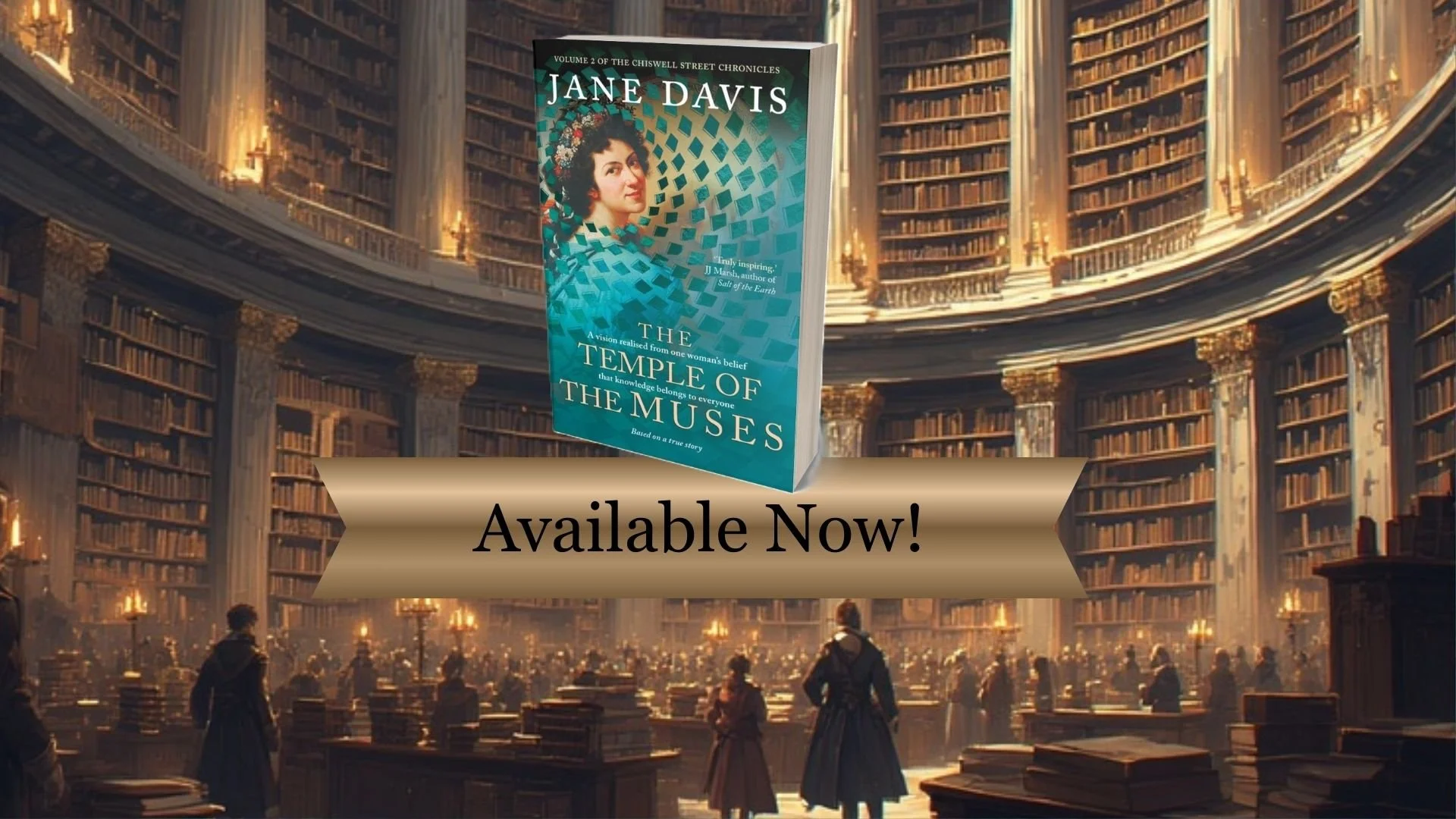
I’m delighted to welcome my friend Jane Davis to the Fictionfire blog again. I’ve long been a fan of her compelling, original and incredibly well-researched novels. She has recently published The Temple of the Muses, the sequel to The Bookseller’s Wife. It follows the further experiences of Dorcas Lackington, who really existed, and who was married to bookseller James Lackington. In late eighteenth century England issues of class, wealth, poverty, education and the role of women all feature in this moving and fascinating story. At the heart of it is Dorcas and her determination to bring books to a wider readership - a desire taken to extraordinary levels by her less-than-modest husband, who sets about building the biggest bookshop ever seen in London … With so much at risk, will his high-flown plans work?
Jane knows that the best of historical fiction draws you into a past era. Here she describes the London the Lackingtons would have known - a London we know and yet don’t know.
The Birth of a Modern Metropolis
How the 1700s reshaped London — and inspired the backdrop to my novel
Walking through London in the 1780s was to encounter a city both ancient and astonishingly new, shaped over the centuries by disaster, reform, and resilience.
For readers of historical fiction, this period offers a metropolis in transition — a place where sections of the Roman wall are still evident, medieval alleyways run between grand new streets, where the legacy of the Great Fire still influences urban planning. A city that is on the threshold of modernity — ambitious, restless, dangerous, and alive with possibility. It is this richly layered London that forms the backdrop to The Temple of the Muses.
To understand Dorcas’s world, it helps to step back a few decades and explore how the city evolved.
The Medieval City Endures
Streets, wards, and daily life within the old City walls
A map of the City from 1720 shows the dark outline of the old city wall enclosing a tightly packed urban core. Major streets such as Cheapside, Ludgate Hill, and Fleet Street are clearly recognisable today, yet around them once spread a dense maze of small lanes and alleys — many now vanished or reshaped.
The City of London was, as it remains, a distinct jurisdiction separate from Westminster and Southwark. While the population of greater London doubled during the eighteenth century to one million people, the City was already overcrowded and remained at roughly 200,000 people. It was divided into twenty-five wards, each with its own distinct character and communities.
Around St Paul’s Cathedral lay bustling commercial areas such as Paternoster Row and Ludgate, alongside institutions like Christ’s Hospital School near Newgate. To the north, Aldersgate Ward encompassed St Bartholomew’s Hospital, Smithfield Livestock Market, and an intricate warren of narrow streets that today’s London cannot rival for complexity.
This crowded, vibrant environment provides the texture of the novel’s setting — a city alive with trade, noise, and human drama.
Reimagining London After the Great Fire
Christopher Wren’s unrealised vision and his lasting influence
The Great Fire of 1666 destroyed seven-eighths of the City of London, offering a rare opportunity to rebuild from scratch. London’s appearance might have been very different had Sir Christopher Wren’s ambitious blueprints been adopted. Inspired by the grand avenues of Paris and Rome, Wren envisioned wide boulevards radiating from elegant piazzas and a magnificent riverside quay replacing the ramshackle wooden wharves along the Thames. His plan even featured a symbolic river god, Tamesis, watching over a burning London. But practicality — and property rights — trumped his architectural ambition, and much of the medieval street plan survived.
St Paul’s Cathedral and the New Urban Landmark
Faith, architecture, and identity in Georgian London
But Wren left his mark on London, designing many of its churches and his masterpiece St Paul’s Cathedral. Completed in 1708, on his birthday, it was more than a London landmark and a place of worship. It served as a powerful reminder of London’s capacity for resilience, recovery and reinvention.
“For every Cheapside wax chandler, silver-and goldsmith, milliner and mantua-maker, there are apprentices and shop-assistants, all of whom need breakfast. Dorcas shoulders her way through the throng. An old man with a patch over one eye and the other rheumy thrusts out a gnarled hand. “Spare some change, mum.” She mutters an apology. In the road, a man hauls a handcart piled with pyramids of onions and turnips, oblivious to the horses and carts, or perhaps not oblivious but stubbornly determined, or not even that, but simply resigned. She too is resigned, her guilty feet guiding her through the city’s arteries towards redemption and ruin. Here is St Paul’s, every traveller’s reference point. It is said that in his enterprise to rebuild the city’s churches, Wren positioned each steeple so that when London is viewed from the surrounding hills, the eye is drawn to its great dome. Even with its Portland stone dulled by city smoke, the cathedral appears as a dream conjured in the mind of a benevolent god.”

Order from Congestion
Roads, bridges, and the opening of the metropolis
The mid-to-late 1700s brought a wave of reforms that reshaped daily life. The Bow Street Runners, established in 1749, marked the beginnings of professional policing. Westminster Bridge opened in 1750, easing the flow of traffic across the Thames. The New Road (today’s Marylebone Road and Euston Road) created London’s first bypass, allowing livestock to be driven to Smithfield Market without clogging the city streets.
Old city gates that had once enclosed London were demolished in 1761, along with the crowded housing that perched precariously on London Bridge — a notorious fire hazard. New paving and lighting acts in the 1760s introduced numbered houses, cleaner streets, drainage, and oil lamps that illuminated the city at night. These reforms improved safety, trade, and social order, though inequality remained stark.
Building the Georgian City
Perhaps most transformative was the Building Act of 1777. By enforcing standards for new housing and dividing properties into regulated “rates,” it curbed the worst excesses of shoddy construction, built only to survive the term of a lease. The result was the orderly Georgian terraces and elegant squares that still define much of London today — uniform, but a symbol of a city’s modernisation.
Alongside improvements in streets and housing, the eighteenth century also witnessed the emergence of what might be called civic London — a city increasingly shaped by institutions dedicated to culture, learning, and public life. Museums, galleries, theatres, hospitals, and concert halls multiplied as wealth from trade and empire flowed into the capital. The British Museum, founded in 1753 and opened to the public in 1759, offered unprecedented access to collections of art, antiquities, and scientific specimens, while purpose-built theatres such as Drury Lane and Covent Garden became central to London’s vibrant social scene. Pleasure gardens like Vauxhall and Ranelagh blended music, art, and spectacle, attracting visitors from across the social spectrum. These spaces reflected a growing belief in improvement, education, and shared urban culture, transforming London from a commercial hub into a centre of intellectual and artistic life.

A Tale of Two Londons
But there is another side of London, one that is hidden from tourists and revellers. It is a story of poverty, overcrowding, crumbling tenements, debtor’s prisons, and labyrinths of alleys where disease and crime flourish. The conditions that shaped Charles Dickens’ grim urban landscapes had their roots in the eighteenth century: stark inequality, child labour, unstable housing, and fragile public order.
“More people live on the streets than ever before in Dorcas’s memory, entire families huddled in doorways. What look like piles of limp rags lie prone on the footway, and who’s to know whether you’d be thanked for shaking them to check if they are alive or dead when only hunger awaits.”
This contrast between refinement and hardship — between the city celebrated by reformers and the city endured by the poor — gives late eighteenth-century London its powerful tension and provides a compelling backdrop for any novelist.
London in the Aftermath of the Gordon Riots
Violence, fear, and the reshaping of urban consciousness
In June 1780, tensions erupted in one of the most dramatic events of this era - the Gordon Riots. What began as a protest against the Catholic Relief Act quickly spiralled into days of chaos. Mobs attacked prisons, chapels, homes of prominent Catholics, and symbols of authority. Newgate Prison was stormed and burned, releasing hundreds of prisoners into the streets. Fires lit up the skyline, eerily recalling memories of the Great Fire more than a century earlier.
The riots exposed deep social tensions — not just religious prejudice, but economic hardship, and resentment toward the government — all simmering beneath the surface of Georgian London.
The riots left psychological scars on the city, reminding Londoners how fragile order was and how quickly it could collapse. In their aftermath, authorities recognised the urgent need for stronger law enforcement and better urban control. But reformers saw the need for change. A fairer society and a redistribution of wealth.
Dorcas Lackington and her husband James would be part of that change, taking the radical step of making books affordable, certain in their conviction that reading and book-learning would provide the surest means of self-improvement and a path out of poverty. They dared to dream of a temple to literature – the biggest bookshop in Europe. And all the while, the tension between stability and upheaval mirrors the emotional journeys at the heart of their story.
I invite you to step into eighteenth-century London and experience this extraordinary city – and its people – at a time of profound change.
Book link: books2read.com/thetempleofthemuses
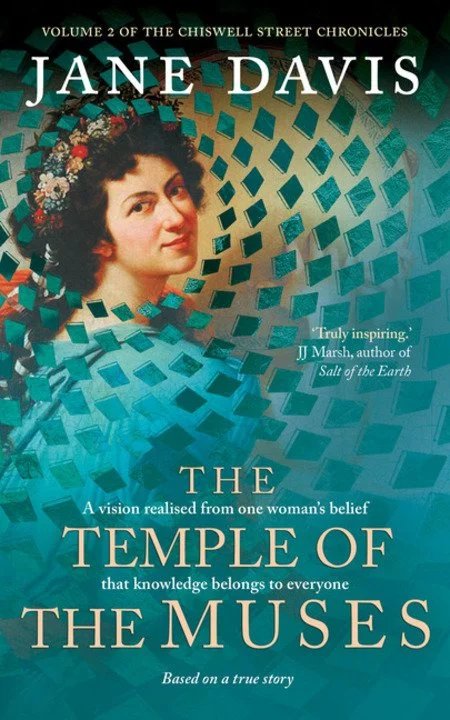
Book Description
Volume 2 of the Chiswell Street Chronicles
The story continues...
London, 1780. As the city smoulders in the aftermath of the Gordon Riots, booksellers James and Dorcas Lackington refuse to answer despair with charity. Instead, they place their faith in something far more radical: books.
Convinced that reading offers the surest escape from poverty, the Lackingtons launch a daring experiment—pricing books so cheaply that even apprentices and servant girls can afford them. It is a bold challenge to the rigid social order of Georgian England, and one that places them squarely in danger.
Dorcas knows that life alongside James and his unshakable optimism will never be smooth. But she is no mere helpmeet. She is his compass, his conscience, and often the sharper mind. In a modest corner of Moorfields, their bookshop ignites a quiet revolution as ordinary people encounter philosophy, liberty, reason, and love for the first time.
Not everyone welcomes this awakening. The Junto, a powerful circle of men who believe that books breed dangerous ideas in the minds of the poor, move swiftly to crush the Lackingtons’ venture. As threats and intimidation escalate, Dorcas realises that survival will not come from retreat—but from becoming too large to silence.
Her answer is audacious: to build a cathedral to literature, not for kings or scholars, but for every woman and man who has ever been told that knowledge is not theirs to claim—The Temple of the Muses.
✨ Perfect for readers of Maggie O’Farrell, Tracy Chevalier, Hilary Mantel, Sarah Waters, and Philippa Gregory, and for anyone who loves women’s historical fiction, book club fiction, and stories about books and the lives they change.
‘One woman’s quiet revolution in a time of flux and ferment.’ ~ Lorna Fergusson, author of The Chase
‘I laughed with them, and cried with them, but most importantly, I loved this story’ ~Bronwyn Kotze
‘A historical novel with a timely, modern message.’ ~ Diane Reid Stevens
About the Author
Jane Davis is the author of character-driven historical and contemporary fiction that bridges meticulous research with compelling emotionally-rich storytelling. Her novels explore subjects ranging from the life of a pioneering female photographer to families searching for justice after a devastating disaster. Interested in what happens when ordinary people are pushed into extraordinary situations, Jane introduces her characters when they’re under pressure and then, by her own cheerful admission, throws them to the lions. Expect tangled relationships, moral crossroads and a smattering of dark family secrets!
Her first novel, 'Half-Truths and White Lies', won a national award established by Transworld in their quest to find the next Joanne Harris. Since then, her books have continued to earn acclaim. She was hailed by The Bookseller as ‘One to Watch’. 'An Unknown Woman' won Writing Magazine’s Self-Published Book of the Year in 2016 and was shortlisted for the IAN Awards. 'Smash all the Windows' won the first ever Selfies Book Award in 2019. 'At the Stroke of Nine O’Clock' went on to be featured by The Lady Magazine as one of their favourite books set in the 1950s and was a Historical Novel Society Editor’s Choice.
Jane lives in a Surrey cottage that was originally the ticket office for a Victorian pleasure garden, known locally as ‘the gingerbread house’. Her home frequently finds its way into her stories – in fact, it met a fiery end in the opening chapter of 'An Unknown Woman'.
When she isn’t writing, you may spot Jane disappearing up the side of a mountain with a camera in hand, or haunting Victorian cemeteries searching for the perfect name for her next character.
You can find her at:
Get a FREE copy of her time-slip, photography-themed eBook, I Stopped Time, when you sign up to her newsletter
